
How Accurate Are AI Baby Generators? The Science Behind the Technology
Discover the science behind AI baby generators, how facial recognition and machine learning work together to predict what your future baby might look like, and understand their accuracy levels.
By AI Baby Generator Team
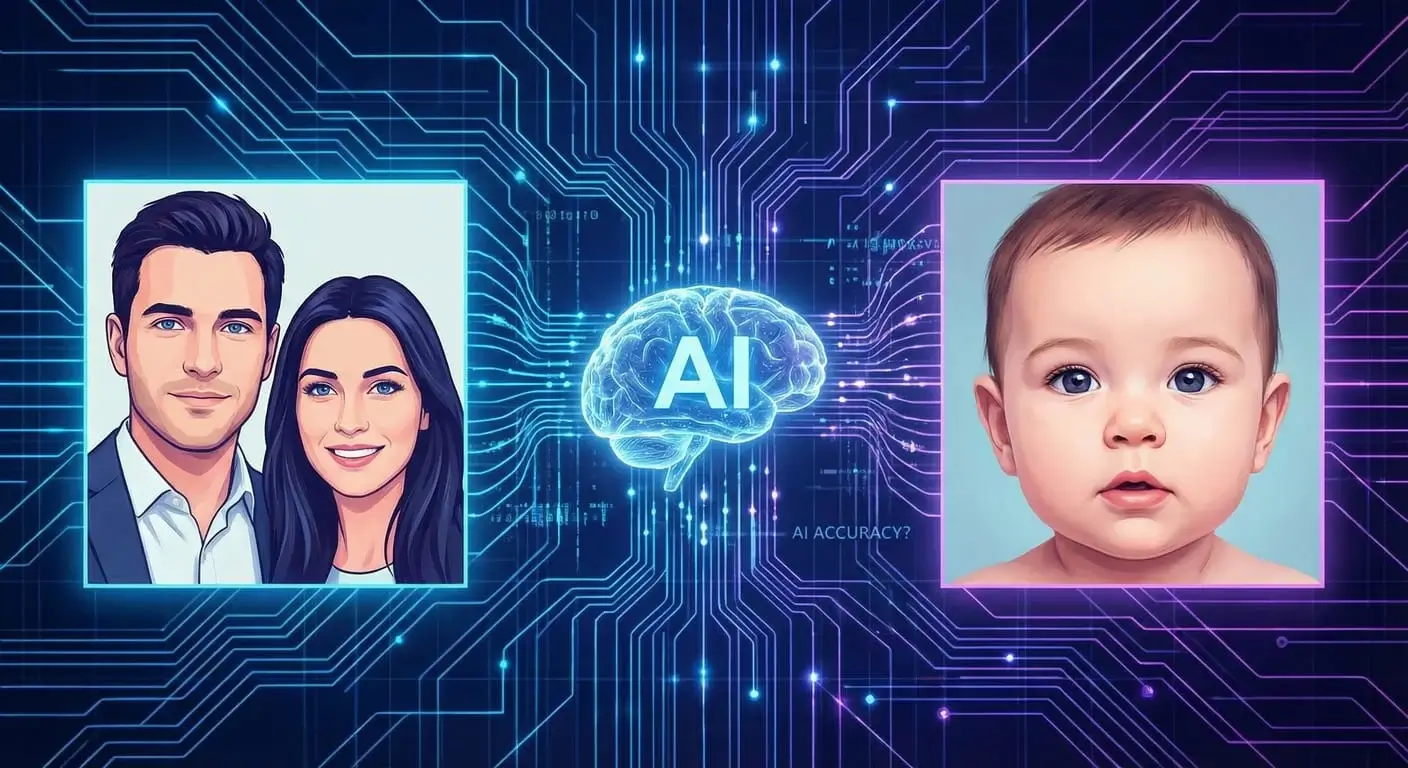
Understanding AI Baby Prediction Technology
Have you ever wondered how accurate AI baby generators really are? With millions of couples using these tools to glimpse their future children, it’s natural to question the science behind the predictions. In this comprehensive guide, we’ll explore how AI baby prediction technology works and what level of accuracy you can realistically expect.
The Science Behind AI Baby Generators
How Facial Recognition Powers Baby Prediction
AI baby generators rely on sophisticated facial recognition algorithms that analyze hundreds of distinct facial features from both parents. These systems use deep learning neural networks trained on millions of facial images to understand the complex relationships between genetic traits and physical appearance.
The technology examines:
- Facial geometry: The distance between eyes, nose width, jaw shape, and overall face structure
- Feature patterns: Eye shape, lip fullness, eyebrow arch, and ear characteristics
- Skin and hair analysis: Tone, texture patterns, and color variations
- Bone structure indicators: Cheekbone prominence, chin shape, and forehead proportions
Machine Learning and Genetic Trait Prediction
Modern AI baby generators use machine learning models that have learned from vast datasets of family photos. These models understand how certain facial features tend to be inherited and can make educated predictions about which parent’s traits might be more dominant.
The AI considers:
- Dominant vs. recessive trait patterns: Some features like dark hair and brown eyes are more likely to appear in offspring
- Feature blending: How certain characteristics combine between two individuals
- Statistical probability: Based on genetic inheritance patterns observed across populations
How Accurate Are AI Baby Predictions?
Realistic Expectations
It’s important to understand that AI baby generators are entertainment tools, not scientific instruments. Real human genetics involves:
- Over 20,000 genes influencing appearance
- Complex interactions between multiple genes for single traits
- Environmental factors during development
- Epigenetic influences that can’t be captured from photos
What AI Can and Cannot Predict
AI performs well at predicting:
- General skin tone range
- Likely eye color tendencies
- Overall face shape similarities
- Hair color possibilities
AI cannot accurately predict:
- Exact feature placement
- Unique genetic combinations
- Features influenced by grandparents or earlier generations
- Environmental effects on appearance
The Technology Stack Behind Baby Prediction
Convolutional Neural Networks (CNNs)
AI baby generators typically use CNNs - specialized neural networks designed for image analysis. These networks can:
- Identify and extract facial landmarks
- Recognize patterns in facial structure
- Generate new images based on learned features
Generative Adversarial Networks (GANs)
Many advanced baby prediction tools use GANs to create realistic baby images. This involves:
- A generator network that creates baby face predictions
- A discriminator network that evaluates realism
- Continuous improvement through adversarial training
Factors That Affect Prediction Accuracy
Photo Quality Matters
The accuracy of your baby prediction depends heavily on the photos you provide:
- High-resolution images allow better feature extraction
- Proper lighting ensures accurate skin tone analysis
- Front-facing angles provide the most facial data
- Recent photos reflect current appearance more accurately
Diverse Training Data
AI models trained on diverse datasets produce more accurate results across different ethnicities. Look for tools that explicitly mention diversity in their training data for better predictions regardless of your background.
Why People Love AI Baby Generators Despite Limitations
Even understanding the limitations, AI baby generators remain incredibly popular because they offer:
- Fun visualization: A playful way to imagine future possibilities
- Conversation starter: Great for couples to discuss genetics and family features
- Keepsake creation: Memorable images to save and compare later
- Bonding experience: A lighthearted activity for expectant or future parents
Making the Most of AI Baby Prediction
Tips for Better Results
To get the most realistic predictions from an AI baby generator:
- Use clear, well-lit photos of both parents
- Choose recent photos that accurately represent current appearance
- Avoid heavily filtered or edited images
- Select photos with neutral expressions
- Ensure faces are clearly visible without obstructions
Understanding the Output
When viewing your baby prediction, remember:
- The image represents one possible outcome among millions
- Real babies are wonderfully unpredictable
- The prediction captures general tendencies, not exact features
- Multiple predictions may show different possibilities
The Future of AI Baby Prediction Technology
As AI technology advances, baby generators are becoming more sophisticated. Future developments may include:
- Better genetic modeling: Incorporating actual genetic data (with consent)
- 3D predictions: More accurate facial structure modeling
- Aging simulation: Predictions at different ages
- Improved diversity: Better accuracy across all ethnicities
Conclusion
AI baby generators use impressive technology combining facial recognition, machine learning, and generative AI to create fun predictions of future children. While they shouldn’t be considered scientifically accurate, they offer an entertaining glimpse into genetic possibilities.
The real magic of having a baby lies in the beautiful unpredictability of genetics. AI predictions are best enjoyed as a playful activity rather than a definitive preview of your future child.
Ready to see what your future baby might look like? Try our free AI baby generator and discover the possibilities!
Disclaimer: AI baby predictions are for entertainment purposes only. Real genetics are complex, and actual babies may look entirely different from any AI-generated prediction.